What is an RSE educator doing at Tech Fest?
It seems like everything is about AI right now. From AI-generated morning and prayer messages forwarded by aunties, to debates about whether that dancing dog video is real or AI-generated, to trying to convince family members that something isn’t fake, AI is everywhere.
The conversation keeps expanding in every direction: fears about AI spreading misinformation; concerns that it is replacing real designers and creatives; excitement about how industries are leveraging AI to maximise productivity; growing worries about data protection and how to protect yourself from AI; and the reality that AI is now being integrated into almost every tech product, internet service, and platform we use.
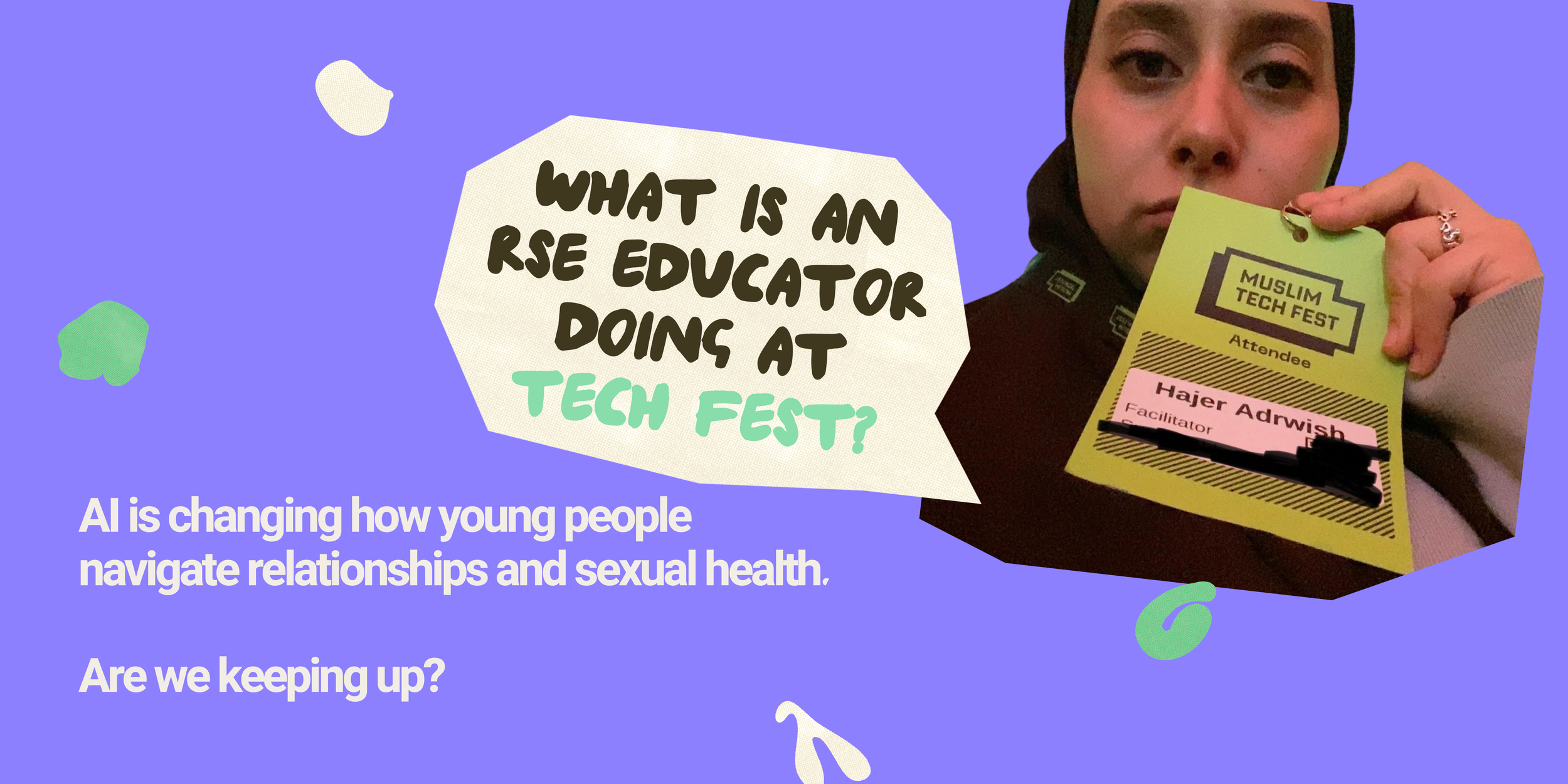
Split Banana’s Programme Coordinator, Hajer, has been exploring how RSE educators can keep up with these changes and help young people make sense of the technology shaping the world around them.
What does the rise of AI mean for Relationships and Sex Education?
AI chatbots are becoming an increasingly popular way for people to create relationships or manage and seek relationship advice. Speaking to what can feel like an impartial “person” may be particularly appealing to everyone, not just the “most vulnerable” and we have seen a rise in children and young people using AI chat bots to manage emotions and answer questions.
Young people are also turning to their popular, addictive algorithms that shape their online experiences for guidance as they navigate their identities, bodies, relationships, sex, sexuality, and their understanding of one another. At the same time, they may encounter or create AI-generated sexualised images: whether through prompts entered into these tools or content presented to them online as if it were real.
For those of us working in RSE, this is particularly relevant to the digital-life elements of the PSHE curriculum. It raises important questions about how we reflect on, adapt and strengthen our work so that it addresses young people’s real online experiences, and the ways these experiences can affect their relationships, wellbeing and sexual health.
Tech Week came at the perfect time and gave me a great opportunity to learn more. My journey began with attending a roundtable at Muslim Tech Fest (MTF) titled “How to raise children in the age of AI?” Exactly the kind of question many people working with young people may already be asking.
I was in a room filled with some of the most amazing and intelligent people: founders, business owners, teachers, therapists, and others from across the UK and as far afield as America, all gathered in a large London hotel for the festival. Most people in the room were parents, discussing, reflecting on, and coming to terms with their own place in the tech world, while grappling with real concerns about what it means to raise children in a world increasingly surrounded by technology.
There was also a strong focus on how AI can support children and young people, particularly in improving accessibility for blind and neurodivergent children, while helping prepare them for the growing role of AI and its presence in their everyday lives.
Many acknowledged that AI is far from perfect and may not be as intelligent as some perceive it to be, with conversations also touching on privacy and surveillance. But the main concern in the room was whether AI risks stripping away the foundations and key learning stages through which children develop their creativity and skills, or whether it could become a tool that replaces meaningful human interaction.
One of the key questions raised by a participant and by the co-founder chairing the session, Arfah Farooq was: How is AI different from parenting handbooks and how is it different from children turning to their peers for guidance?

Muslim Tech Fest, London June 2026.
What does this mean for RSE practice?
This made me think about the RSE perspective: How are young people using AI to navigate questions about identity and sexuality before speaking to adults or peers? For some, AI may feel like a way to avoid awkwardness, judgement or difficult emotions, while still accessing information and support to help them make sense of their experiences, feelings and needs.
There is also something important to consider about what we want young people to learn about relationships themselves. AI can provide immediate answers, but it cannot replace the experience of navigating disagreement, reading another person’s responses, communicating boundaries or working through uncertainty with another human being. RSE has an important role to play in creating opportunities for young people to practise these skills, rather than simply providing information.
Young people are likely to seek information in spaces that feel familiar, accessible and tailored to them. This can include AI chatbots, as well as algorithms that recommend videos, posts and other content. The information they encounter may feel more relevant or accessible than conversations with parents or teachers, but it is not always nuanced, reliable, accurate or age-appropriate.
When searching for information about sex, bodies and relationships, children and young people may also encounter explicit content or material that is unsuitable for their age. Without an understanding of how AI tools and algorithms work, they may not recognise that these systems are not impartial. AI-generated responses can sound confident and feel personal, yet still be inaccurate, biased or shaped by the prompts a young person enters.
This makes it increasingly important for RSE to support young people in critically engaging with AI and online content, understanding the limitations of these tools, and recognising where to find trustworthy information, guidance and support.
This doesn’t necessarily mean that RSE needs to teach young people how to use AI. Rather, it means helping them develop the skills to question what they encounter online: Who or what is giving me this information? Why might it be telling me this? Can I trust it? And where else can I turn for support or a different perspective? These are increasingly important relationship and digital literacy skills.
Some of the suggestions raised in the room focused on monitoring online activity while teaching healthy behaviours, creating supportive and safe environments, building media literacy, and helping young people understand what is appropriate to share online and what should remain private. There was also an important reminder that AI is still a product and, like any product, needs to be developed and used responsibly.
The proposed social media ban and its limits
That leads us to what seems like the government’s attempt to protect children: the social media ban recently proposed and expected to be enacted in spring 2027. But how does this address the needs of young people? For the last 15 years, the government has stripped away physical services designed to meet these needs and fill those gaps. Taking away another source of social connection raises difficult questions.
Children were interviewed and reacting to this proposed new law, many laughed at the child in the BBC interview who was asked how they would fill their time if they could no longer access social media and who replied, “stare at a wall?”. But that is a real and raw answer. If public free spaces are being taken away and services are being stripped back, who do young people turn to? And will they turn more towards AI chatbots and tech for company?
No one yet knows exactly how the social media ban will look once it is enacted. But it places young people in a difficult position: how will they be prepared for the internet when they can legally access it? What skills should we be teaching the younger generation now? Does the ban extend to alternative messaging apps such as WhatsApp and Telegram? What about online games and chat rooms? Chat rooms are nothing new, and the same worries existed when they were first introduced.
There is also a growing conversation about the lack of online spaces designed specifically for young people. Could this encourage founders and organisations to create digital spaces tailored to teens and young people? These are spaces that many young people and adults alike feel have been lost, despite once offering an important environment for connection, exploration and social interaction. For many millennials, these spaces helped shape their early experiences of the internet, providing a more gradual transition into online social life. Could creating similar spaces today offer young people a healthier way to navigate the digital world than the one they are growing up in now?
Who is responsible for safer online spaces?
This social media ban has opened up more questions: who has the responsibility to protect people from potential harm? There are places like Australia that have started adopting healthier habits around internet use, such as algorithm-free weekends, as a way to build a healthier relationship with the internet.
But this still places much of the responsibility on individuals. Social media platforms are products, so why aren’t they regulated in the same way as food, clothing and other technologies that must be reconsidered, redesigned or reshaped when they pose risks or fail to serve users safely?
Realistically, harmful messages do not exist only on social media; they are also created, circulated and amplified across other parts of the internet. Does this mean that young people are left more vulnerable when the conversation focuses narrowly on social media as a social tool, rather than considering the wider digital ecosystem they navigate? By looking at social media in isolation, are we missing the bigger picture of how young people encounter, absorb and make sense of harmful content online?
But because of this, some other important news and action have been overshadowed. The government has also proposed more responsibility on tech firms to remove harmful content. At the moment, they say this should happen within 48 hours: that still feels like a very long time for harmful content to remain online. For many organisations that have been campaigning for stronger responsibility from companies, this is a step in the right direction.
Additionally, responding to harmful content after the fact is not the same as preventing the harmful content from going online in the first place.
And once again, there is the question of algorithms being intentionally coded and designed to be addictive. What measures are being put in place to create a healthier online environment? Some might argue that the capitalist, addictive nature of online spaces needs to change entirely.
It takes me back to what many of us remember: slower, more skills-based social platforms, where you had to learn to code to create your own unique space. Those spaces were less about sharing personal details and more about sharing skills, creativity, and thoughts. Maybe this is nostalgia speaking, but it was definitely different, and some might argue it was preferable, as it wasn’t built on capitalistic, addictive, surveillance-style platforms that have become the norm.
One thing is certain: if young people’s relationships are increasingly shaped and mediated by algorithms, digital platforms and AI, then understanding these technologies must become part of how we prepare them to build and navigate healthy relationships.